What is Granulation?
Definition:
Granulation may be defined as a size enlargement process which converts fine or coarse particles into physically stronger and larger agglomerates having:
- Good flow property
- Better compression characteristics
- Uniformity
The art and science for process and production of granules is known as Granulation Technology. Granulation Technology can be broadly classified into 2 types based upon the type of processing involved:
Dry Granulation
Granule formation without using liquid solution
Wet Granulation
The most widely used process in pharmaceutical industry
Reasons for Granulation:
- To prevent segregation of the constituents of the powder mix
- To improve the flow properties of the mix
- To improve the compaction characteristics of the mixture
- To reduce the hazard of toxic dust powders
Dry Granulation
Dry granulation involves granule formation without using liquid solution as the product may be sensitive to moisture and heat. In this process dry powder particles may be brought together mechanically by compression into slugs or by roller compression to obtain flakes.
Steps in Dry Granulation:
- Milling of drugs and excipients
- Mixing of milled powders
- Compression into large, hard tablets to make slug
- Screening of slugs
- Mixing with lubricant and disintegrating agent
- Tablet compression
Dry Granulation Techniques
Slugging Technique:
This process involves compression of primary powder particles into large flat tablets or pellets using a tablet press or, more usually, a large heavy-duty rotary press. The resultant compact is then milled using a hammer mill or other conventional milling equipment. The milled slugs are passed through a screen of desired mesh for sizing. Lubricant is added in the usual manner, and the granules compressed into tablets.
Shortcomings of Slugging:
- Considerable dust production which poses a problem for good containment and reduction of cross contamination
- Batch processing
- Low throughput (30–50 kg/hr)
- Poor process control
- Frequent maintenance changeovers
- Poor economy of scale
The method is being replaced by the more modern, and better, roller compaction process.
Roller Compactors:
Roller Compactors are used to force fine powders between two counter rotating rolls and presses the raw materials into a solid compact (flakes, sheets, strips). Roll Compactors are also called dry granulators.
A roller compactor generally consists of three major units:
- A feeding system, which converts the powder to the compaction area between the rolls
- A compaction unit, where powder is compacted between two counter rotating rolls to a ribbon by applying a force
- A size reduction unit, for milling the ribbons to the desired particle size
Important Parameter:
The most important parameter in the dry granulation process is the force applied on the powder compacted between two rolls. The applied force is expressed in kN/cm, being the force per cm roll width.
Main Process Variables:
- Compaction Pressure i.e. compaction force per cm of roll width
- Speed of feeding screws
- Roll Speed
Configuration Types:
Roller compactors come in different configurations: A. Vertical, B. Inclined, C. Horizontal
Wet Granulation
Wet granulation is the most widely used process of granulation in the pharmaceutical industry. It involves addition of a liquid solution (with or without binder) to powders, to form a wet mass or it forms granules by adding the powder together with an adhesive, instead of by compaction.
The wet mass is dried and then sized to obtain granules. The liquid added binds the moist powder particles by a combination of capillary and viscous forces in the wet state. More permanent bonds are formed during subsequent drying which leads to the formation of agglomerates.
Wet Granulation Techniques
Four Major Techniques:
Following are the 4 major techniques which are used for wet granulation process:
1. High Shear Mixture Granulation
High shear mixture has been widely used in Pharmaceutical industries for blending and granulation. In this type of equipment, the particles are set into movement by an impeller rotating at a high speed (Approx 50-100 rpm). Equipment also contains a chopper which rotates at around 1500–4000 rpm.
Chopper Function:
The primary function of chopper is to cut large lumps into smaller fragments thus increases the binder distribution into the blend.
Binder Addition:
The binder liquid is added by pouring, pumping or spraying from the top.
Wet Agglomeration Phases:
Wet agglomeration in a high-shear mixer involves typically 3 phases:
- Dry Powder mixing (Approx 2-5 mins)
- Liquid binder addition (Approx 1-2 mins)
- Wet massing
Post-Wet Massing Processing:
After the wet mass is produced, it is further processed to obtain dried grade particle size granules:
- Wet sieving of granules
- Drying
- Dry sieving of granules
Advantages:
- Short processing time
- Lesser amount of liquid binders required compared with fluid bed granulation
- Highly cohesive material can be granulated
Disadvantages:
- Mechanical degradation could take place in case of fragile particles
- Due to increase in temperature chemical degradation of thermo labile material could be resulted
- Over wetting of granules can leads to large size lumps formation
Critical Considerations:
- The liquid amount is critical, because the process is susceptible for over-wetting, which leads to uncontrollable agglomerate growth
- Variations in raw materials may affect the liquid requirement
- Impeller torque and power consumption of mixers have been used to monitor the properties of wet masses during agglomeration
Fluid Bed Granulation
Fluidization Principle:
Fluidization is the operation by which fine solids are transformed into a fluid like state through contact with a gas. At certain gas velocity, the fluid will support the particles giving them free mobility without entrapment.
Process Description:
Fluid bed granulation is a process by which granules are produced in single equipment by spraying a binder solution onto a fluidized powder bed. The material processed by fluid bed granulation are finer, free flowing and homogeneous. The system involves the heating of air and then directing it through the material to be processed. Later, the same air exit through the voids of the product.
Historical Context:
Fluid bed processing of pharmaceuticals was first reported by Wurster, by using air suspension technique to coat tablets later used this technique in granulating and drying of Pharmaceuticals for the preparation of compressed tablets.
System Components:
Air-Handling Unit (AHU)
Product Container and Air Distributor
Spray Nozzle
Disengagement Area and Process Filters
Exhaust Blower or Fan
Control System
Solution Delivery System
Advantages:
- It reduces dust formation during processing, thus improves housekeeping
- It reduces product loss
- It improves worker safety
Disadvantages:
- The Fluid Bed cleaning is labor-intensive and time consuming
- Difficulty of assuring reproducibility
Extrusion-Spheronization
This process is primarily used as a method to produce multi-particulates for controlled release application. It is a multiple step process involving at least 5 steps capable of making uniform sized spherical particles.
- Dry mixing of materials to achieve homogeneous dispersion
- Wet granulation of the resulted mixture to form wet mass
- Extrusion of wet mass to form rod shaped particles
- Rounding off (in Spheronizer)
- Drying
These dried rounded particles can be optionally screened to achieve a targeted mean size distribution. Figure describes schematically the steps involved in the extrusion spheronization process.
Spray Drying
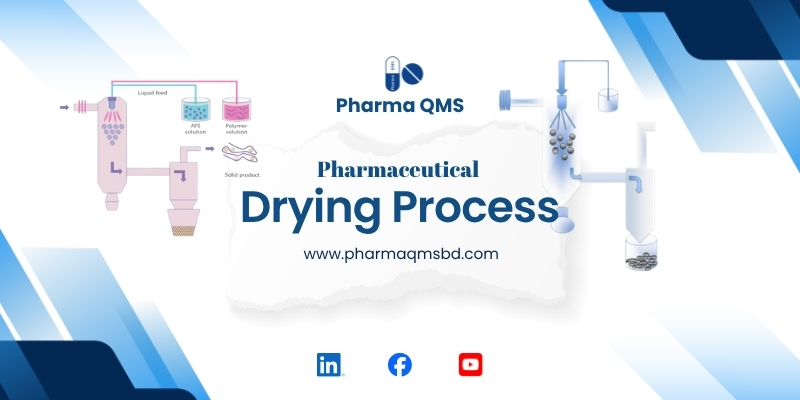
Spray Drying as a process has been used to produce microcapsules, food ingredients, flavors, and various biotechnological preparations. This process differs from the methods discussed above in that it is a continuous process in which a dry granular product is made from a solution or a suspension rather than initially dried the primary powder particles.
The solution or suspension may be of drug alone, a mixture of different excipients or a complete formulation. As long as the liquid solution or suspension feed to the drying system, dry powder product continues to be produced.
Functional Principle:
- Heating: Heat the inlet air to the desired temperature (max. 120 °C)
- Droplet formation: ultrasonic spray head
- Drying chamber: Conductive heat exchange between drying gas and sample droplets
- Particle collection: electrostatic particle collector
- Outlet filter: Collection of finest particles to protect the user and the environment
- Drying gas: Delivered by aspirator or compressed air
Spray Drying Applications:
Microencapsulation:
The preparation of microcapsules involves the coating of particles or liquid droplets with a biodegradable polymer. Applications for microspheres in the pharmaceutical industry include controlled release, particle coating, flavor stabilization, taste masking, and physical or chemical stabilization.
Other Uses:
- Inhalation Dosage Forms
- Nanoparticles
- Peptides and Proteins
- Dry Elixirs and Emulsions
- Effervescent Products
End-Point Determination in Wet Granulation
Most challenging task while performing wet granulation in high-shear mixers is the detection of end point and reproducibility of same end point by controlling various process variables. End-point can be defined by the formulator as a target particle size mean or distribution.
Principle of Equifinality:
It has been shown that once you have reached the desired end-point, the granule properties and the subsequent tablet properties are very similar regardless of the granulation processing factors, such as impeller or chopper speed or binder addition rate. This is called "the principle of equifinality".
The ultimate goal of any measurement in a granulation process is to estimate viscosity and density of the granules, and, perhaps, to obtain an indication of the particle size mean and distribution. These factors may be monitored and controlled by use of suitable measuring devices to achieve reproducibility in the process.
1. Power Consumption
Measurements of Power Consumption of the mixer motor have been widely used for end point determination because measurement is economical and well co-related with the growth of granules. Power consumption can also be co-related with mean particle size of the granules although it is not linear in the entire range. Intra granular porosity also shows some correlation with power consumption.
Significant Drawback:
Significant drawback of the power consumption measurement is that it reflects load on the motor rather than load on the impeller where actual action is being performed and can vary with time regardless of the load.
Lindberg Correlation:
S = H(1-e) / e * P
Where: S = saturation level, H = mass ratio of liquid to solid, e = intra-granular porosity, P = density of the particle relative to the density of the liquid
The saturation level S of an agglomerate is defined as the ratio of pore volume occupied by liquid to the total volume of pores available in the agglomerate.
2. Impeller Load
Load on the main impeller can be estimated by measuring current in DC motor because torque generated by the impeller is proportional to the current applied. Current meter (ammeter) can be used for small scale DC motors. In case of AC motor impeller load does not vary linearly with the current applied therefore current is completely ineffective as a measurement of impeller load in AC motor.
Power ~ Torque * Speed
Impeller power consumption can be calculated as a product of the direct torque, rotational impeller speed, and a coefficient (usually equal to 2 times a unit conversion factor, if required).
3. Impeller Torque
In wet granulation process change in impeller torque and power consumption of the impeller occurs as a result of change in the cohesive force or the tensile strength of the granules in the powder bed. Therefore impeller torque is an excellent in-line measurement of the load on the main impeller.
Torque rheometer has been extensively used for the off-line measurement of torque required to rotate the blade of the device and this torque has been used to access rheological properties of the granules and the end point of the granulation process. The torque value thus obtained was termed as "measurement of wet mass consistency" which describes the rheological properties of the wet mass.
4. Liquid/Binder Solution Addition
Both moisture content and rate of addition of binding solvent is important in successful attainment of granulation end point. Mean granule size is strongly dependent on the specific surface area of the excipients, as well as the moisture content and liquid saturation of the agglomerate.
Critical Observations:
- During the wet massing stage, granules may increase in size to a certain degree while the intra-granular porosity goes down
- Binder addition rate controls granule density, while impeller and chopper speed control granule size and granulation rate
- Slow addition of solvent or binder solution to the blend is a preferred method of choice to avoid local over wetting