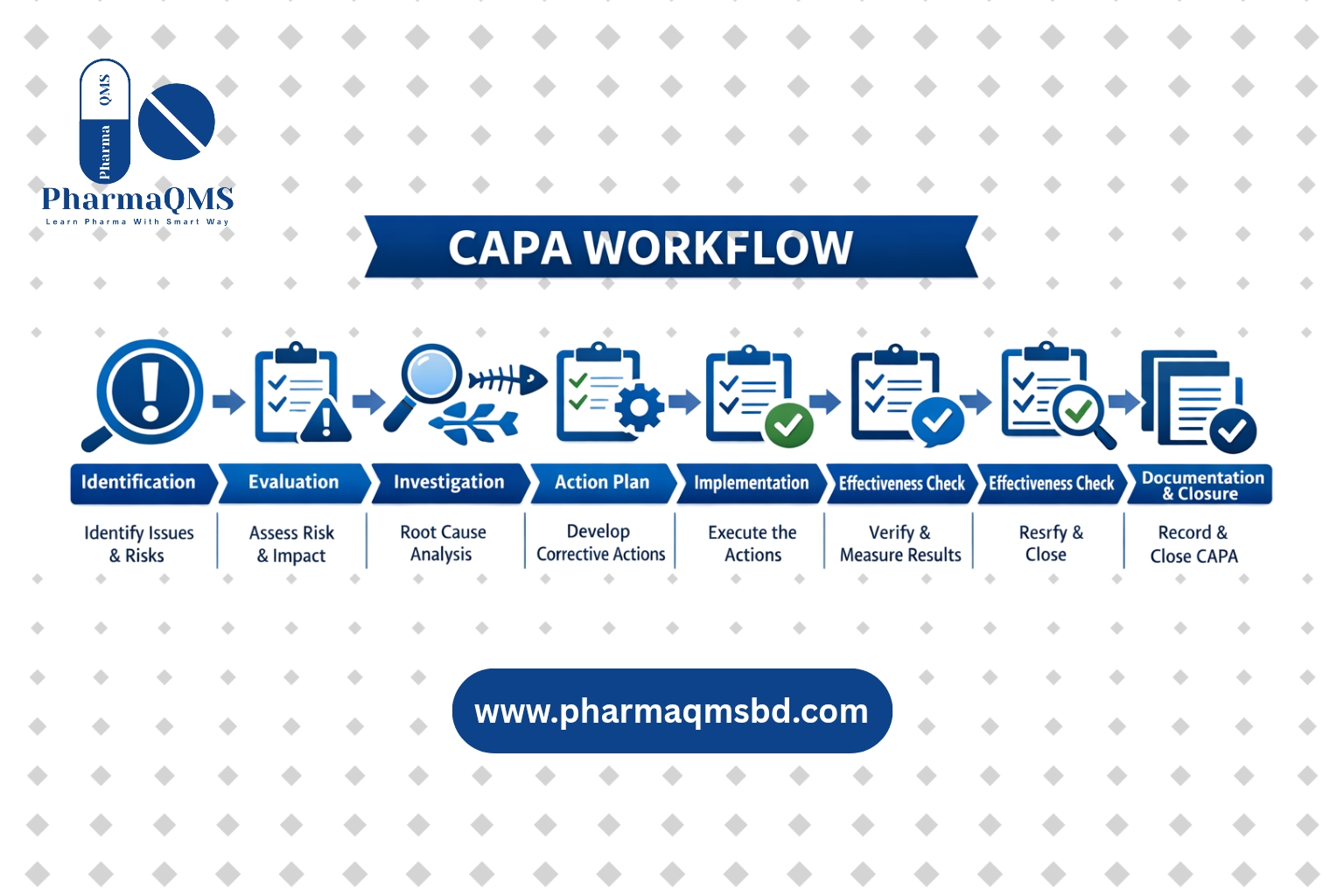
In regulated industries like Pharmaceuticals, Biologics & Medical Devices, the Annual Product Quality Review (APQR) is a cornerstone of GMP compliance and continuous improvement. It represents a systematic, periodic review of product quality data to verify the consistency of the manufacturing process, assess trends, identify risks, and determine opportunities for improvement.
Why is APQR Required?
APQR is a regulatory requirement that serves multiple critical functions in quality management:
- Ensures products are consistently manufactured & controlled to quality standards
- Identifies trends, deviations, and risks early for proactive management
- Confirms the manufacturing process remains validated and in control
- Captures opportunities for CAPA and continuous improvement
- Demonstrates compliance with regulatory expectations during audits
Strategic Value of APQR
Beyond mere compliance, APQR provides strategic benefits:
- Data-Driven Decision Making: Converts raw quality data into actionable intelligence
- Risk Mitigation: Identifies potential quality issues before they affect patients
- Process Optimization: Reveals opportunities for efficiency improvements
- Regulatory Confidence: Builds trust with health authorities through documented oversight
- Knowledge Management: Captures institutional knowledge about product performance
- Supply Chain Assurance: Evaluates vendor performance and material quality
Types of Product Quality Reviews
Different regulatory frameworks and product scenarios may require variations in the approach to product quality review:
Frequency: Yearly review as per most regulatory requirements
- Scope: Comprehensive review of all quality data for the calendar year
- Application: Standard approach for most pharmaceutical products
- Regulatory Basis: Required by FDA, EU GMP, WHO, and other major authorities
Product Quality Review (PQR)
- Frequency: Annual review (EU terminology)
- Scope: Same as APQR but using European regulatory terminology
- Application: Required for products marketed in European Union countries
- Regulatory Basis: EU GMP Chapter 1.4 specifically mandates PQR
Periodic Quality Review
- Frequency: May be less frequent than annual (with justification)
- Scope: Similar to APQR but adapted for specific situations
- Application: For legacy products, low-volume products, or discontinued products
- Regulatory Basis: Requires specific justification and regulatory approval
Bracketed/Grouped APQRs
- Frequency: Annual review covering multiple products
- Scope: Combined review of similar products (justification required)
- Application: For similar strengths, formulations, or pack sizes within a product family
- Regulatory Basis: Must be scientifically justified and approved by Quality unit
APQR Content Checklist
An effective APQR provides comprehensive coverage of all aspects impacting product quality. The following elements should be included:
🔹 Product & Batch Manufacturing Data
Complete listing of all batches manufactured during the review period, including batch numbers, manufacturing dates, batch sizes, and yields.
🔹 Review of Critical Process Parameters (CPPs)
Analysis of CPPs to ensure they remain within validated ranges and identification of any trends or shifts in process performance.
🔹 In-process & Finished Product Test Results
Statistical analysis of all analytical test results, including comparison to specifications and identification of any trends.
🔹 Deviations, OOS, OOT & Investigations
Summary and analysis of all deviations, Out-of-Specification (OOS) results, Out-of-Trend (OOT) results, and associated investigations.
🔹 Change Controls & Impact Assessment
Review of all implemented changes and their impact on product quality, process validation status, and regulatory filings.
🔹 Stability Study Results & Trends
Analysis of ongoing stability data, including any trends that may indicate shelf-life concerns or storage condition issues.
🔹 Complaints, Returns & Recalls (if any)
Summary of customer complaints, product returns, and any recall activities with root cause analysis and corrective actions.
🔹 CAPA Effectiveness Review
Evaluation of the effectiveness of Corrective and Preventive Actions implemented in response to previous quality issues.
🔹 Vendor & Raw Material Performance
Assessment of supplier performance, including raw material quality, delivery reliability, and any supplier-related quality issues.
🔹 Previous APQR Action Status
Update on the implementation status of actions identified in previous APQR reports, including any delays or challenges.
🔹 Conclusion & Recommendations
Overall assessment of product quality status and specific recommendations for improvements, process changes, or additional studies.
Regulatory Framework
APQR requirements are established in multiple international regulatory guidelines. Understanding these requirements is essential for compliance:
ICH Q10 – Pharmaceutical Quality System
Provides the framework for a comprehensive pharmaceutical quality system that includes management review and continual improvement.
EU GMP Chapter 1 & Chapter 1.10
Establishes quality management principles and requires regular quality management reviews.
EU GMP Chapter 1.4 (PQR)
Specifically mandates Product Quality Review for authorization holders in the European Union.
US FDA 21 CFR 211.180(e)
Requires written records to be maintained for at least one year after the expiration date and be available for FDA inspection.
WHO TRS – Product Quality Review
Provides guidance on product quality review requirements for WHO prequalified products.
Schedule M (India) – Ongoing Evaluation
Mandates ongoing product quality evaluation as part of Indian Good Manufacturing Practices.
Auditor Perspective
During regulatory inspections, auditors evaluate APQR effectiveness by asking:
- Is the APQR process clearly defined in SOPs?
- Are APQRs completed within the required timeframe?
- Do APQRs include all required elements?
- Are trends properly analyzed and interpreted?
- Are identified issues followed up with appropriate CAPA?
- Is there evidence that management reviews and acts on APQR findings?
Key Insight: Auditors don't just ask "Do you have APQR?" They ask "What decisions came out of it?"
APQR Process Flow
A systematic approach ensures APQR effectiveness and regulatory compliance:
1. Data Collection
Gather all relevant quality data from the review period (typically one calendar year) including manufacturing records, test results, deviations, complaints, stability data, and change controls.
2. Data Analysis & Trend Evaluation
Perform statistical analysis to identify trends, patterns, and anomalies. Compare current data with historical data and established control limits.
3. Report Preparation
Document findings in a structured APQR report following the approved template. Include data summaries, trend analyses, conclusions, and recommendations.
4. Quality Unit Review
The Quality unit reviews the report for completeness, accuracy, and appropriate interpretation of data. Any discrepancies or gaps are addressed.
5. Management Review & Approval
Senior management reviews the APQR findings, approves the report, and authorizes any recommended actions or CAPA initiatives.
6. Action Implementation & Follow-up
Implement approved actions and track their effectiveness. Monitor progress in subsequent APQR cycles to ensure continuous improvement.
A strong APQR is evidence that your Quality System is
alive — not just documented.
– Quality Management Principle
APQR Maturity Assessment
Organizations evolve in their approach to APQR. Assess where your organization falls on this maturity scale:
Level 1: Compliance-Driven
APQR is done primarily to meet regulatory requirements. Reports are generated but with minimal analysis or actionable insights.
Level 2: Process-Oriented
Standardized APQR process exists with defined templates and timelines. Basic trend analysis is performed.
Level 3: Data-Informed
Statistical tools are used for trend analysis. Findings are reviewed by cross-functional teams. Some improvement actions are initiated.
Level 4: Improvement-Driven
APQR is integrated into business decision-making. Proactive risk identification drives preventive actions. Management uses APQR for strategic planning.
Level 5: Excellence-Embedded
APQR is a cornerstone of continuous improvement culture. Predictive analytics are used. Findings drive innovation and product lifecycle management.
Best Practices for Effective APQR
- Start Early: Begin data collection well before the deadline to allow time for thorough analysis
- Use Technology: Implement electronic systems for data collection and analysis to improve efficiency
- Cross-Functional Involvement: Engage representatives from Manufacturing, Quality Control, Regulatory, and Supply Chain
- Focus on Trends: Look beyond individual data points to identify patterns that indicate process drift
- Link to CAPA: Ensure APQR findings feed directly into the CAPA system for tracked resolution
- Management Ownership: Secure senior management commitment to act on APQR recommendations
- Continuous Improvement: Use APQR findings to drive process improvements and innovation
- Training: Ensure personnel involved in APQR preparation are properly trained on requirements and techniques