All Posts
0 posts
Nonverbal Communication in Community Pharmacy - Study Note
Interpersonal communication is a common but complex practice essential for effective pharmacy practice. While we engage in countless interactions daily, successful communication requires understanding the underlying process that occurs when one person tries to express ideas or exchange information with another.
Hospital and Community Pharmacy
Principles and Elements of Interpersonal Communication - Community Pharmacy Study Note
Interpersonal communication is a common but complex practice essential for effective pharmacy practice. While we engage in countless interactions daily, successful communication requires understanding the underlying process that occurs when one person tries to express ideas or exchange information with another.
Hospital and Community Pharmacy
Patient-Centered Communication in Pharmacy Practice - Study Note
he evolution of pharmacy practice has shifted from a product-oriented, medication-dispensing model to a patient-centered care model where communication is the cornerstone of therapeutic success. This transition reflects the growing recognition that medication-related problems often stem from communication failures rather than pharmacological deficiencies.
Hospital and Community Pharmacy
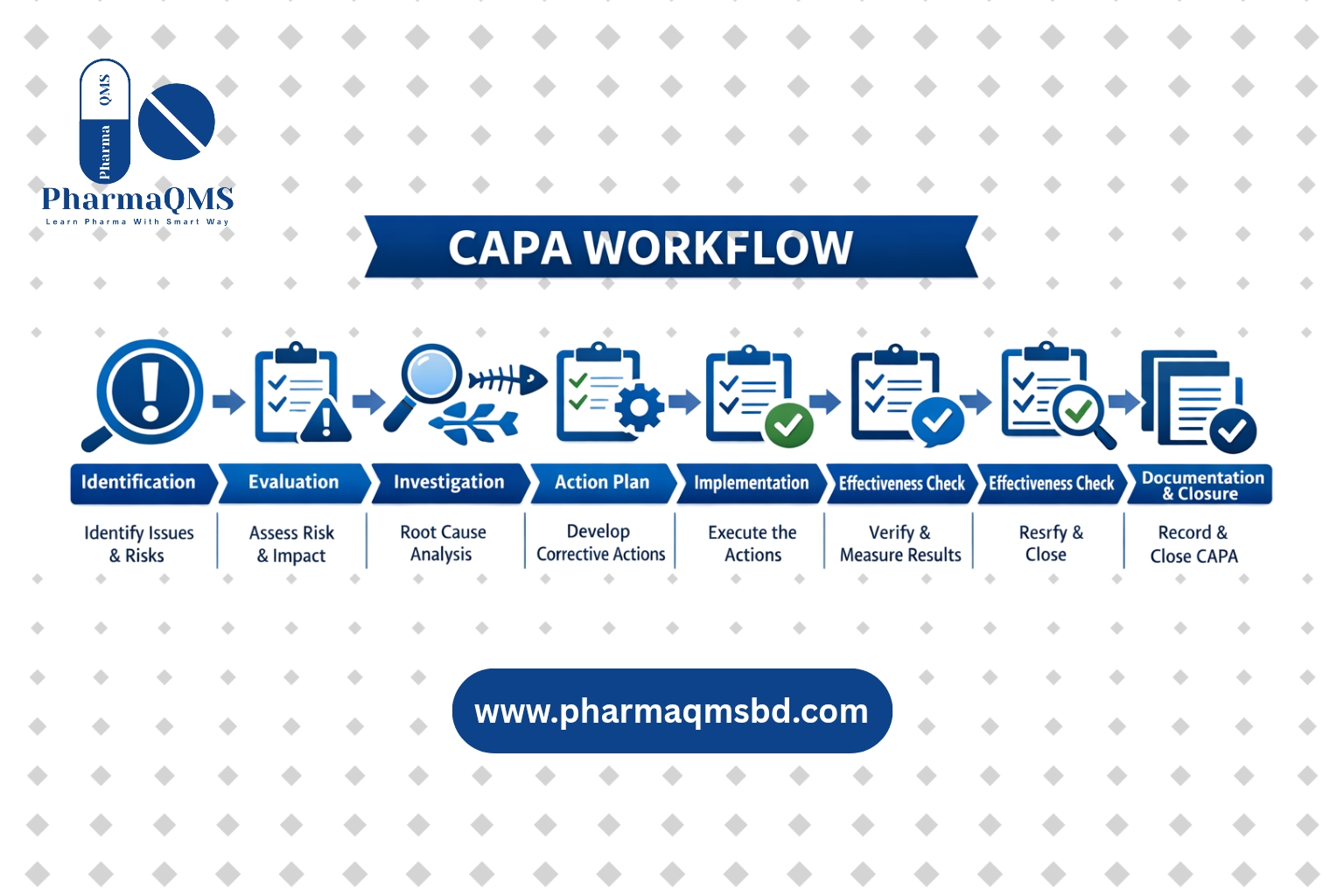
Pharmaceutical CAPA Management Workflow
A well-defined CAPA system ensures product safety and regulatory compliance and drives continuous improvement.
Quality Assurance
_20260225_235322_0000.jpg)
Anticancer Herbs and Phytoconstituents from Nature
Cancer represents one of the most significant global health challenges, characterized by uncontrolled cellular proliferation and high mortality rates. Conventional allopathic therapies, while effective to some degree, are often associated with severe side effects, high costs, and frequent recurrence. This has driven scientific interest toward natural alternatives—specifically herbs and phytoconstituents—that may offer preventive, prophylactic, and therapeutic benefits with better safety profiles and accessibility for broader populations.
Pharmacognosy
Pharmaceuticals Tablet Formulation and Design - Study Notes
ablets are solid pharmaceutical dosage forms containing drug substances prepared either by compression or molding methods. Although tablets can be manufactured in a wide range of shapes, official tablets are typically defined as circular with either flat or convex faces.
Technology
Bioavailability Studies in Tablet Formulation - Study Notes
In the case of generic formulations, tablet formulations may be studied directly in humans. This approach is based on the reference product's established safety profile and the need to demonstrate bioequivalence.
Technology
Stability Data for Pharmaceuticals Tablet Formulations - Study Notes
Stability studies provide essential information about how the quality of a drug product varies with time under the influence of environmental factors such as temperature, humidity, and light.
Technology
Process Validation in Tablet Formulation and Design - Study Notes
Process Validation defines process validation as "establishing documented evidence which provides a high degree of assurance that a specific process will consistently produce a product meeting its predetermined specifications and quality characteristics.
Technology
Pharmaceuticals Granulation Technology -Study Notes
Granulation may be defined as a size enlargement process which converts fine or coarse particles into physically stronger and larger agglomerates having:
Good flow property
Better compression characteristics
Uniformity
Technology
Quality by Design (QbD) in Pharmaceuticals Tablet Formulation - Study Notes
Pharmaceutical QbD is a systematic, scientific, risk-based, holistic and proactive approach to pharmaceutical development that begins with predefined objectives and emphasizes product and processes understanding and process control.
Technology
Tablet Components and Additives Comprehensive Study Notes
A pharmaceutical excipient is defined as an inactive ingredient or any component other than the active ingredient added intentionally to the medicinal formulation or everything in the formulation except the active drug. Pharmaceutical excipients are also called additives, pharmaceutical ingredients, or inactive pharmaceutical ingredients.
Technology
New Applications of Hospital Pharmacy - Study Notes
The hospital is a complex organization utilizing a combination of intricate, specialized scientific equipment, and functioning through a corps of trained people educated to the problem of modern medical science.
Hospital and Community Pharmacy
Hospital Pharmacy Interview Questions & Answers
According to WHO, "The hospital is a complex organization utilizing combination of intricate, specialized scientific equipment, and functioning through a corps of trained people educated to the problem of modern medical science."
Hospital and Community Pharmacy
USP Guidelines on Environmental Control including related Guideline
"Monitoring can not identify and quantify all microbial contaminants present.”
“Microbiological monitoring of a clean room is technically a semi-quantitative exercise, given the limitations in sampling equipment."
Guideline
Short Notes on HPLC Peak-to-Valley Ratio
The Peak-to-Valley ratio (P/V ratio) is a critical chromatographic system suitability parameter used to evaluate how well a main analyte peak is separated from a closely eluting impurity or adjacent peak.
Analysis
Concepts of Molarity, Molality, and Normality for pharmaceutical professionals
Molarity is the number of moles of solute per liter of solution. It is the most commonly used concentration unit in pharmaceutical preparations.
Pharmaceutical Applications:
Preparation of intravenous (IV) fluids
Formulation of ophthalmic solutions
Standardization of titrants in analytical chemistry
Preparation of buffer solutions
Analysis
Pharmaceutical Quality Control Hand Notes
Principle: HPLC is an analytical chemistry technique used to separate, identify, and quantify components in a mixture.
It relies on pumps to pass a pressurized liquid solvent containing the sample mixture through a column filled with solid adsorbent material.
Each component interacts differently with the adsorbent material, causing different flow rates and separation.
Job Preparation
Basic HPLC for Pharmaceutical Quality Control Department
High-Performance Liquid Chromatography (HPLC) is an analytical technique used for separating, identifying, and quantifying components in a mixture, used widely in pharmaceuticals, environmental testing, and food analysis.
Quality Control
Computer System Validation Interview Q&A - Part 1
Computer system validation is the process of ensuring that a computer system meets the requirements of a specific regulatory standard. It is important in regulated industries because it helps ensure data integrity, product quality, and patient safety.
Job Preparation
Pharmaceuticals Interview Q&A – Production Basics
What is continuous mixing?
A. A process that provides uninterrupted supply of freshly mixed material, often using pipes or chambers with recirculation.
Job Preparation
Pharmaceutical Interview Questions Based on Mathematical and Case Study of Production and Formulation
Differential, Mathematical & Case Study Interview Questions
Advanced Technical Q&A for Pharma Manufacturing Professionals.
Calculate the Reynolds number for fluid flow in a mixing tank with diameter 0.5m, impeller speed 200 rpm, fluid density 1050 kg/m³, viscosity 0.1 Pa·s.
Job Preparation
Pharmaceutical Production Based 20+ Comparison Questions
1. Difference between Wet Granulation vs Dry Granulation.
2. Fluid Bed Processor vs High Shear Mixer for Granulation.
3. Immediate Release vs Sustained Release Tablets.
4. Sugar Coating vs Film Coating of Tablets.
5. Ointment vs Cream vs Gel.
6. Hard Gelatin Capsules vs Soft Gelatin Capsules.
7. Laminar Flow vs Turbulent Flow in Mixing.
8. Spray Drying vs Freeze Drying (Lyophilization).
9. Ball Mill vs Hammer Mill.
10. Newtonian vs Non-Newtonian Fluids.
11. Direct Compression vs Wet Granulation for Tableting.
Job Preparation
Analytical Method Validation - Hand Note (Step by Step)
Step-by-Step Guideline- Analytical Method Validation
A. Accuracy: Accuracy expresses the closeness of agreement between the test result and the true (accepted) value.
[Short Note: Accurate result for different concentration.]
Validation