All Posts
0 posts
Basic HPLC for Pharmaceutical Quality Control Department
High-Performance Liquid Chromatography (HPLC) is an analytical technique used for separating, identifying, and quantifying components in a mixture, used widely in pharmaceuticals, environmental testing, and food analysis.
Quality Control
HPLC Basics - Comprehensive Study Note
HPLC is an abbreviation for High Performance Liquid Chromatography (previously referred to as High Pressure LC).
Key difference from LC: In principle, LC and HPLC work the same way except the speed, efficiency, sensitivity and ease of operation of HPLC is vastly superior.
Quality Control
Pharmaceuticals Cleaning Validation
Cleaning validation is documented evidence that an approved cleaning procedure will reproducibly remove the previous product or cleaning agents used in the equipment below the scientifically set maximum allowable carryover level.
Cleaning Validation is not monolithic; it requires a comprehensive, science-based approach throughout the product lifecycle.
Quality Control
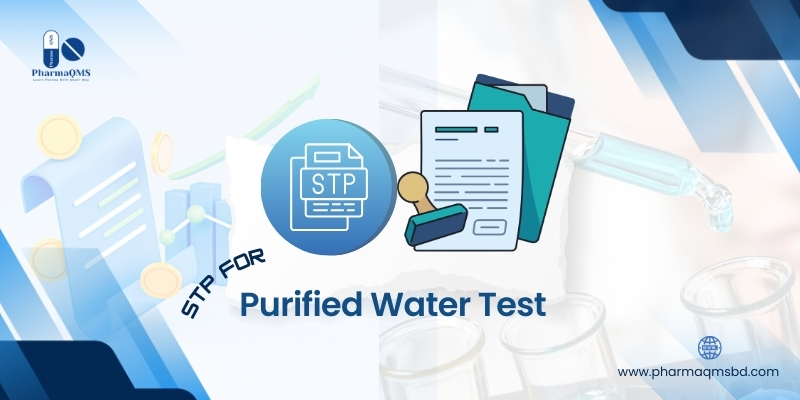
Purified Water Test Procedure in Pharmaceuticals
01. METHOD OF ANALYSIS
i) Appearance
Clear, odorless and colorless liquid.
ii) pH
Transfer 100ml water to a suitable container; add 0.3ml of saturated potassium chloride solution and stirring water, then measure the pH using calibrated pH meter.
Quality Control
Pharmaceuticals Raw Material Test Method - Aceclofenac
01. Appearance: Spread approximately 3.0 g of sample over a white paper and examine visually. Check the appearance for color, nature and any visible foreign particles. Record its appearance, extraneous matter, if any. The sample should be white or almost white, crystalline powder.
Quality Control
OOS Investigation in Pharmaceuticals
In pharmaceutical quality control, an Out‑of‑Specification (OOS) result is defined as a test result that falls outside the established acceptance criteria as defined in the Standard Testing Procedure (STP), drug application, or pharmacopoeial monograph. OOS results indicate a potential quality issue that requires systematic investigation to determine if the result reflects the true quality of the batch or if it was caused by an error during testing.
Quality Control
Good Laboratory Practices (GLP)
Good Laboratory Practices (GLP)A Visual Guide to Ensuring Quality, Reliability, and
Integrity in La...
Quality Control
Purified Water Test Procedure in Pharmaceuticals
i) Appearance: Clear, odorless and colorless liquid.
ii) pH: Transfer 100ml water to a suitable container; add 0.3ml of saturated potassium chloride solution and stirring water, then measure the pH using calibrated pH meter.
iii) Conductivity: Transfer 100ml water to suitable container and immerse electrode then stirring the water, measure the conductivity and Total Dissolved Substances (TDS) using calibrated conductivity meter.
Quality Control